Learned, but not applied
After the course, people still don't know which tool fits the problem in front of them.
AI inside the business, improvement every day
ABS studies the Danaher Business System (DBS) and turns lean management methods, learning resources and AI workflows into everyday capabilities: understand the problem, choose a tool, act and review the result.
Already have an account?Log in
NewABS Skill: put ABS to work in your AI agent


Scattered material, organised into operating resources you can search, learn from and combine.
11,000+pages
Research and teaching material
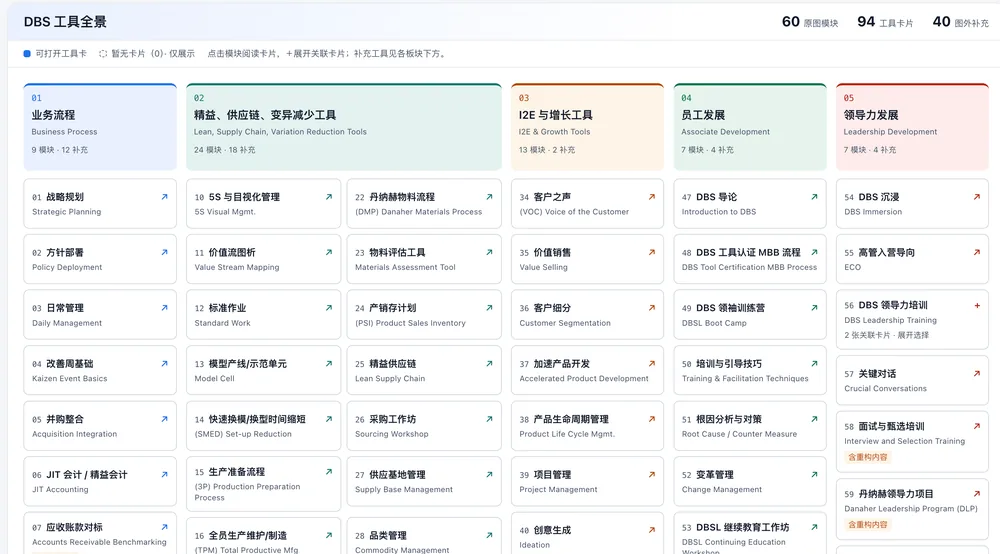
94
Tool cards
809scenes
Tool-card guides
1,423
Animated short lessons
540+
Forms
1,600+
Rules and parameters
Figures follow the counting rules of the current version and change as it evolves. Materials, courses and rules are counted separately and do not add up, and not every rule entry is wired into automated execution.
The problem
Training, business data and improvement projects sit in different places, so teams struggle to keep reusing one way of working.
After the course, people still don't know which tool fits the problem in front of them.
When a metric turns red, facts, root causes, countermeasures and owners end up recorded in different places.
Experience stays with individuals, and the next manager or the next plant starts from scratch.
ABS connects learning, tools and business records, so methods find their way into daily work.
Origins
ABS studies the Danaher Business System (DBS) and applies its method structure to building operating knowledge and software capabilities.
1988: Danaher forms DBSContinuous improvement runs through operations and growth
From research to product
A systematic study of the Danaher operating system and related practice, organised into terms, tool cards, courses, forms and rules.
Not just knowledge on display: it is organised into product capabilities you can search, learn from, plan with, record in and review.
Individuals can learn, FDE teams can deliver, companies can connect their data, and large enterprises can go further with private deployment.
Turning in-depth study of a world-class operating system
into capabilities every person and every team can use.
ABS is an independent product. Drawing on DBS methods does not make it an official Danaher product or imply Danaher certification.
Coverage
A shared operating language that connects policy deployment, shop-floor improvement and cross-functional work.
Delivery, capacity, inventory, quality and process improvement
Customer understanding, product opportunities and value propositions
Role capabilities, coaching and a culture of improvement
Strategic goals, project management and business assurance
Overview
Every entry point leads to the relevant methods, courses or business tools.
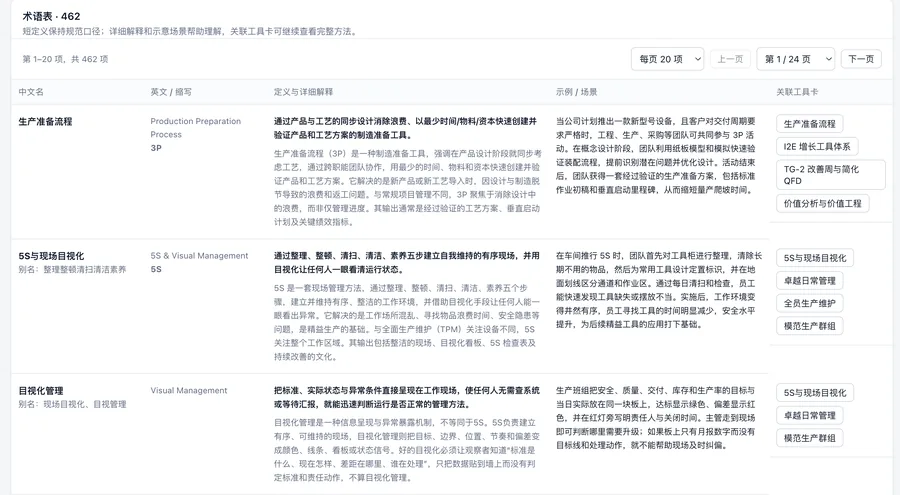
Resource overview, courses, cases, glossary search
Find the right knowledge fast
AI assistant, explanations, notes and process planning
Shape the next step
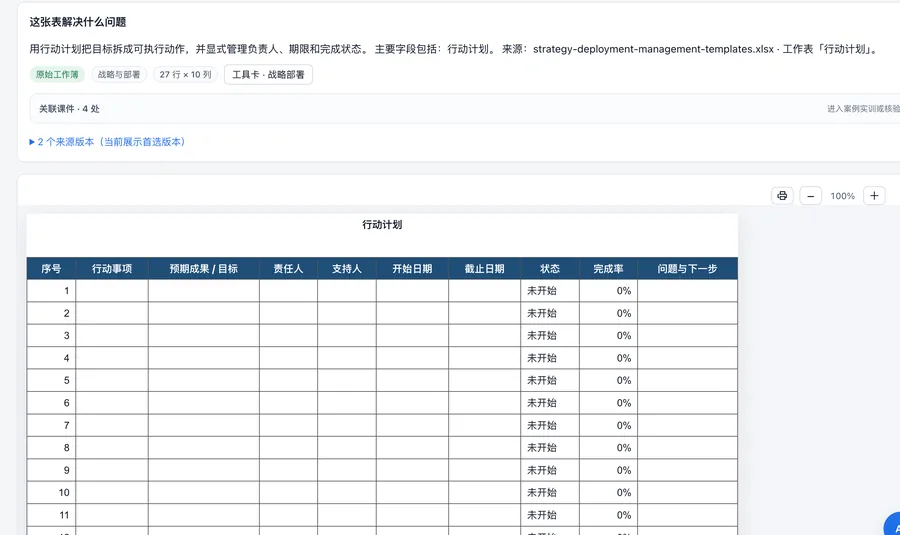
Forms, management boards, policy deployment, problem resolution
Put methods to work
Rule parameters, standard versions, audit trail and review briefings
Keep a traceable record
Product
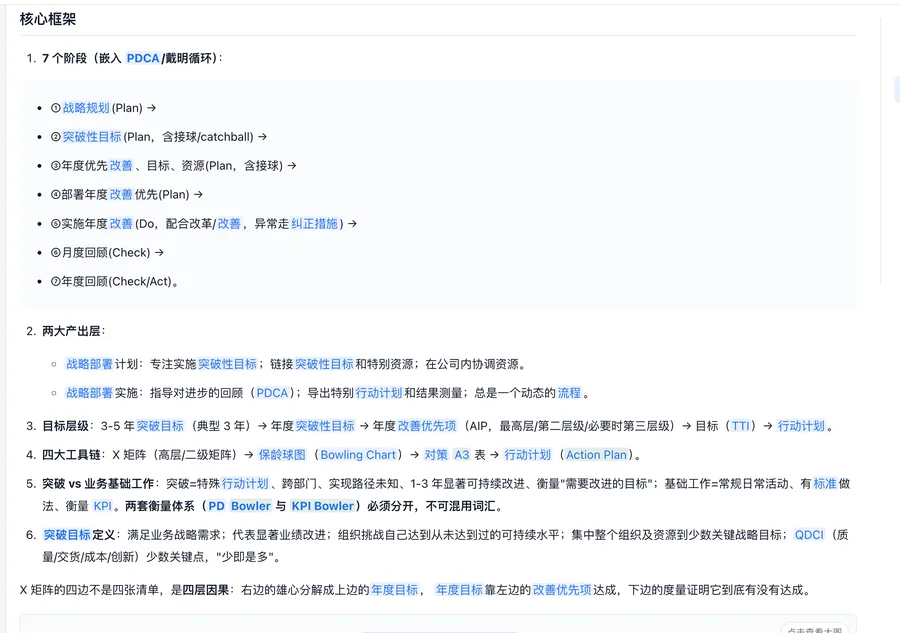
Everything below is a real screenshot of the current version of ABS. The screens show the Chinese interface; ABS also has an English one.


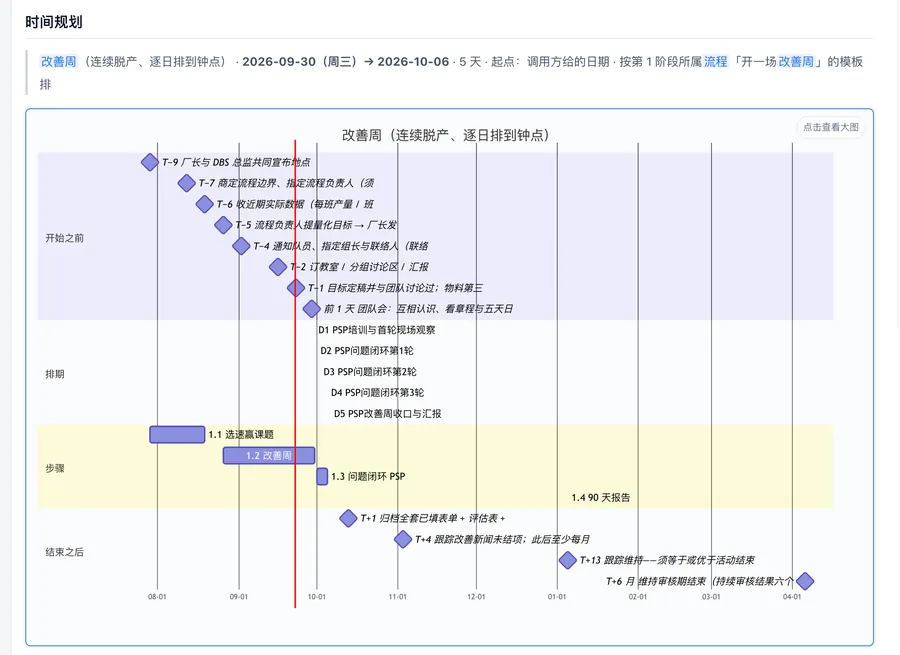
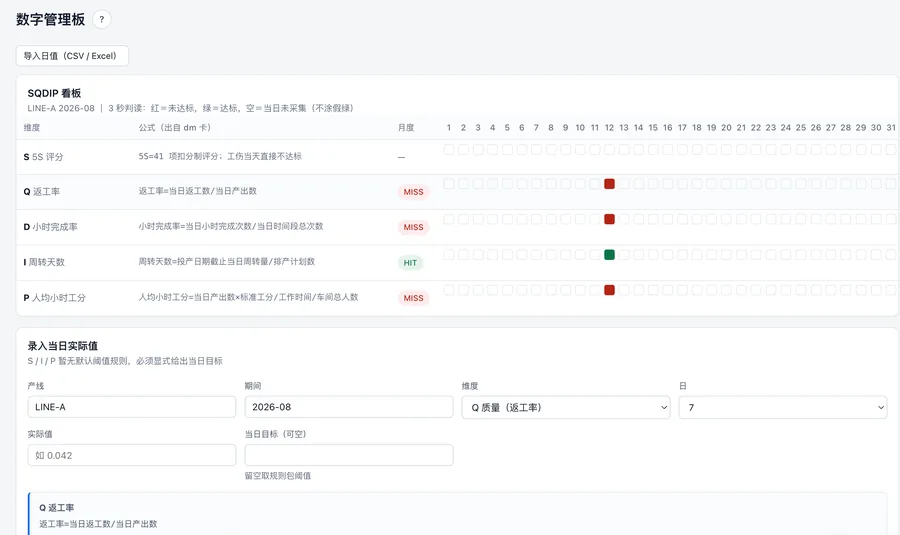
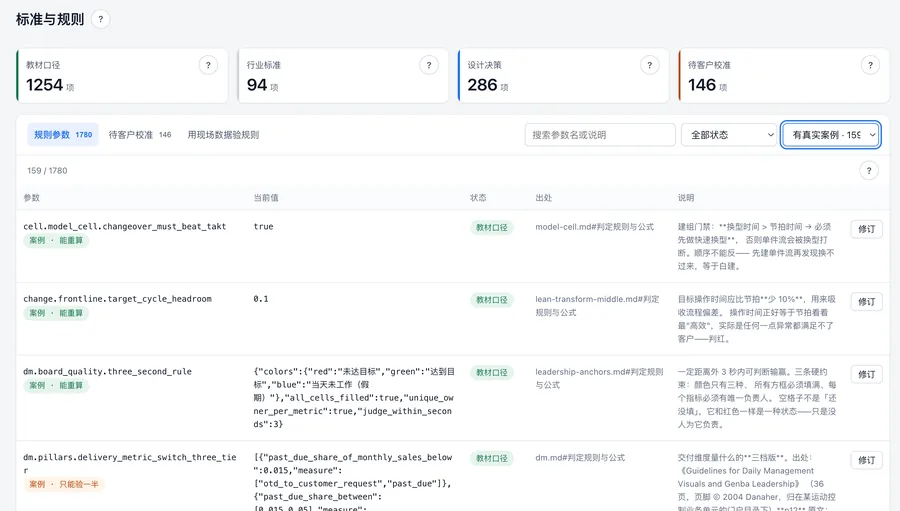
AI agents
With the ABS Skill installed, AI agents such as WorkBuddy, Claude Code and Codex call ABS when they need it: to look up methods, answer with sources, teach a course, draft a plan or run a diagnosis. Answers come from the ABS knowledge base, with links to the sources.
Use ABS to plan a Kaizen Event next Monday to raise first-pass yield on line L1
Calling ABS · plan
A draft plan is ready in ABS:
Projects and tasks are created only after you confirm it in ABS
Get it from the public ABS page and install it in your agent; the site address is already inside.
Sign in to ABS and create one under Personal Settings → Access tokens. It is shown only once.
Paste the token into the chat, then just say what you need.
The token works only on the agent API; permissions, visibility and expiry follow the account, and it can be revoked at any time. Plans are saved as drafts and take effect only after a person confirms them in ABS. An ABS account is required.
Example
From one red cell on the management board to an updated piece of standard work.
This is an illustrative flow. A live rollout is configured around the customer's data, role permissions and management rhythm.
Enterprise safeguards
Rules, models and people each do the part that suits them, and the system keeps a traceable record.
Rules
Formulas, thresholds and checklists handle what can be decided with certainty.
AI
It explains problems, recommends tools, and proposes root-cause hypotheses and plans.
People
Key changes and responses follow role permissions and authorization levels.
Records
Standard changes, metric definitions and operation audits are easy to review.
Who it's for
The value path runs from individual learning to running the business, then on to FDE delivery and private deployment for large enterprises.
For lean practitioners, manufacturing engineers, managers and anyone who wants to learn operating methods systematically.
Where to startPick a topic, take one short lesson, and use a tool on one real work problem.
When forward-deployed engineers (FDEs) work at a customer's site, they need a business foundation for finding methods, assembling plans, connecting data and keeping evidence.
ValueFDEs spend more of their time understanding the customer, configuring scenarios and proving business value.
Roadmap
Existing knowledge and tools are the base; data integration and continuous diagnosis are planned and delivered per customer scenario.
NoteThese are future integration directions, not connectors or automated diagnosis services that are all available today.
For groups, multi-division companies and customers who need knowledge and AI capabilities in a controlled environment.
PrinciplePrivate deployment is not a one-off installation. It is the joint design of data, permissions, processes and operating responsibilities.
Identify which tier a customer is in first, then choose the entry point, the delivery approach and the deployment boundary.
Suggested pilot
We suggest one business unit and one key scenario. Timeline and deliverables are agreed together at kickoff.
Value acceptance
Agree the baseline and targets before the pilot, then review against the same definitions afterwards. Pick the metrics that fit the scenario.
Shows: whether improvement has reached real operations
Shows: whether teams solve problems faster
Shows: whether methods become organisational assets
Prove the value in one scenario first, then decide how far to expand.
This is a suggested route, not a fixed timeline or a promise of results. Actual duration depends on IT conditions, data quality and how involved the business is.
Understand · Apply
Explore Danaher Business System methods through the work you own. These answers connect lean learning with practical routes for your role and business challenge.
Find a route for your roleDBS is Danaher’s approach to running a business through continuous improvement, supported by the culture that puts it into practice. It connects customer needs, work processes, team behaviors and business results through fact-based improvement and follow-through.
ABS studies these methods and connects learning, tool use and business records. Read Danaher’s own explanation of DBS, then choose an application route for your work.
A tool addresses a particular problem. An operating system also defines why to act, who owns the work, when to review it and how to sustain the result. Use 5S, standard work, value stream mapping and kanban in the context of customer value and process conditions. Policy deployment, daily management, voice of the customer and talent development connect improvement with business priorities, growth and capability.
In ABS, learn when a tool applies, practice decisions in a scene guide, then apply it to an actual work output. Explore tool cards, guides and the glossary.
Choose a small problem with observable facts: waiting orders, repeat rework or a task that remains difficult after training. Read the relevant tool card, watch short lessons and explore the scene guide. Then create a flow map, problem analysis or draft work standard and ask someone familiar with the work to review it.
Learners, operations leaders, quality engineers, sales teams and trainers have different responsibilities. Start from your role rather than reading every resource in sequence. Follow the learning-to-work route.
For late delivery, investigate queues, the value stream and constraints. For recurring defects, distinguish verified facts from root-cause hypotheses, then use problem solving and error proofing to test countermeasures. For excess stock and shortages, check demand, replenishment time and material status before choosing PFEP, pull or kanban.
Define the work object, measurement rules and constraints before selecting a tool. Test one change you can review.
When processes, metric definitions and responsibilities are unclear, faster AI output does not necessarily improve the work. Define one business object, reliable inputs, decision criteria and a responsible reviewer. Use AI to find methods, organize evidence and draft actions; verify implementation and outcomes against facts.
You do not need to complete an enterprise-wide transformation before trying AI. Start with a scoped business experiment, an owner and a baseline, and measure benefits alongside review effort and rework. Plan an AI business pilot or learn how to assess business value.
Get started
From individual learning to enterprise delivery: bring deeply researched operating methods into real work.
No account needed to request a trial. Both open in a new window.